Safety is often discussed as something that happens after delivery: the inspection, the training, the certificate. In practice, most of a tower ride’s safety is designed and specified before the order is placed. The restraint system, the control logic, the emergency lowering arrangement and the wind envelope are all fixed at that stage, and they are difficult to add later.
This article lists the safety features a buyer should check before ordering a 42m sky flyer ride for sale, what each one protects against, and what evidence should accompany it in the technical offer.
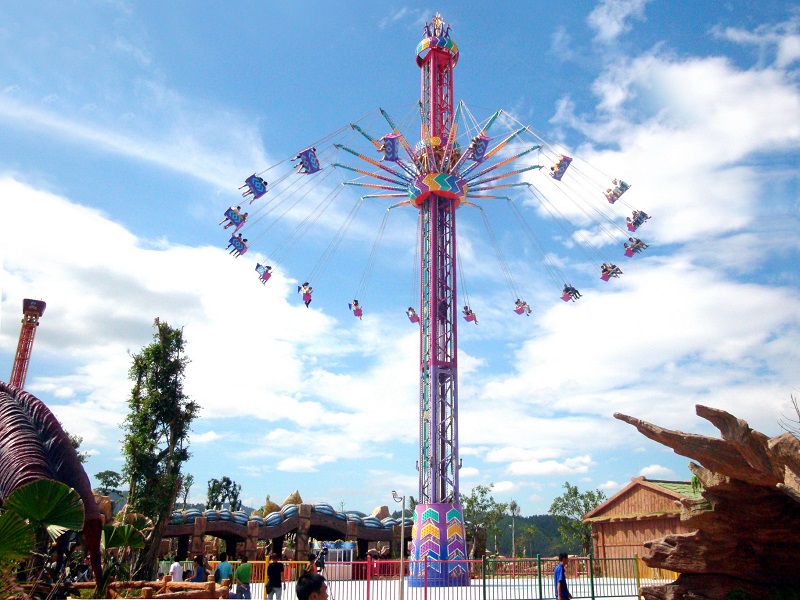
1. Safety Starts in the Specification
A quotation that lists “safety devices” without naming them is not a specification. A serious offer states the restraint type, the number of locking points, the monitoring method, the limit switches, the emergency lowering system and the wind monitoring threshold.
Buyers should treat these items as mandatory line entries rather than options. A tower flying chair ride carries passengers to height, and a feature that is left out to reduce the price is a feature that cannot be added by the operator after commissioning.
2. Restraint Systems: Redundancy and Monitoring
Every seat needs a restraint that locks securely and cannot be released by the passenger during the ride. The best systems are redundant: two independent locking elements, or a primary lock plus a secondary catch, so a single failure does not release the seat.
Just as important is the monitoring circuit. The control system should be able to verify that every restraint is closed and locked before dispatch, and should display the status of each seat to the operator. Ask how the system detects a partially closed restraint and what happens if a sensor fails.
3. Motion Limits and Control Logic
The ride should have defined limits for height, rotation speed and swing amplitude, enforced by the control system rather than left to operator judgement. Ask for the programmed limits, the way they are verified at commissioning and the method for changing them if the ride is reconfigured.
A sky swing ride also needs a smooth acceleration and deceleration profile. Abrupt stops are uncomfortable at height and can indicate that the drive or brake system is undersized for the passenger load.
4. Emergency Lowering and Power Failure
The most important question to ask about any tower ride is: how do passengers get down if the power fails? The answer should be a defined, tested system, not a manual procedure improvised at the time.
Common arrangements include a battery-backed lowering system, a manual winch or a gravity descent mechanism, depending on the design. Whatever the method, it should be tested at commissioning, demonstrated to the operator team and documented in the emergency procedure.
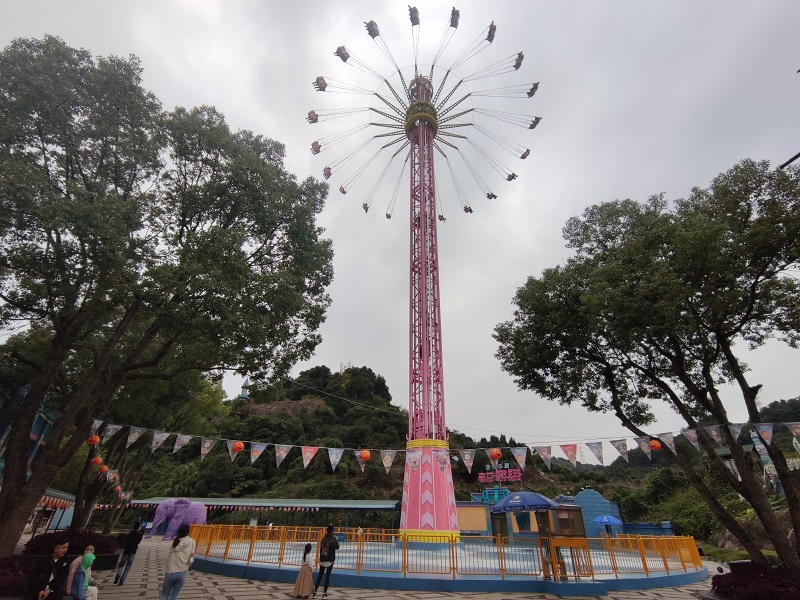
5. Wind Monitoring and the Operating Envelope
A tall tower has a maximum operating wind speed, and that limit should be enforced automatically by an anemometer connected to the control system. The system should prevent dispatch above the limit and display the current wind speed to the operator.
Ask how the limit was derived, whether it accounts for gusts as well as average speed, and what the procedure is when the limit is approached during a cycle. The wind envelope is one of the few safety parameters that differs by site rather than by machine.
6. Structural Safety: Materials, Welds and Testing
The structure is fabricated from steel, typically carbon steel sections selected for the loads and the climate. The buyer should ask for material certificates, welding inspection reports and the surface treatment specification.
Load testing at commissioning is the final structural check: the ride is operated with test weights and inspected for deflection, vibration and fastener movement. The test record should be part of the handover documentation and should be available to the local inspector.
7. Documentation and Certification
Safety is also a paperwork exercise. The package should include the operation and maintenance manual, the electrical schematics, the load test record, the welding reports, the material certificates and the certification documents relevant to the destination market.
Buyers should confirm which certificates the local authority will accept before ordering. A certificate that is not recognised in the destination country can delay registration even when the ride itself is sound.
Where a third-party inspection is required, agree the scope before delivery: the inspector may need to witness welding, review the load test and examine the control logic, not just inspect the finished tower. Scheduling that inspection into the commissioning plan avoids a second visit later.
8. What to Check at Commissioning
- Every restraint locks and is monitored before dispatch
- Motion limits are programmed and verified
- Emergency lowering works with the main power isolated
- Wind monitoring stops dispatch above the limit
- Emergency stop and interlocked control panel function correctly
- Load test completed and recorded
- Operator team trained and signed off
- Emergency procedure documented and practised
9. A Buyer’s Safety Checklist
Before signing, ask for the restraint specification, the control philosophy, the emergency lowering method, the wind limit and its derivation, the material and welding documentation, and the list of certificates the manufacturer can provide. Then confirm that the installation and commissioning scope includes a full safety demonstration.
A sky swing tower by Dinis is quoted with these systems itemised, because they are part of the machine’s design rather than accessories. Dinis has supplied tower rides, ferris wheels, swing chairs and complete park equipment packages from Zhengzhou, China for more than twenty years. As an amusement ride equipment maker, the company provides the technical documentation, load test records and commissioning support that a buyer needs to verify the safety case rather than take it on trust.
Current project reference: https://www.dinisdreammyland.com/products/42-m-sky-flyer-ride-for-sale/
Leave a Reply