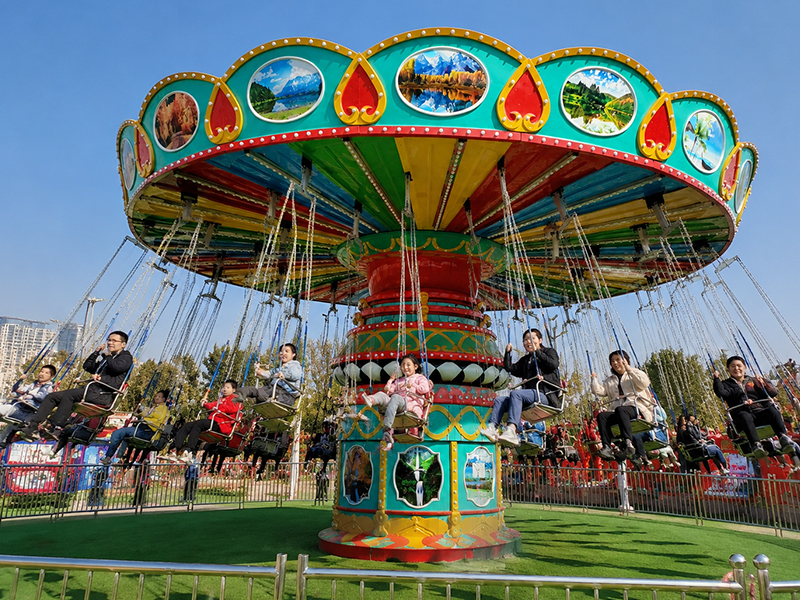
A park that needs more capacity usually starts by planning another attraction, yet the cheapest answer is often a ride that carries more guests on the land it already occupies. A 36-person wave swinger does exactly that. This guide explains how a 36 people wave swinger ride capacity can absorb a growing queue without new land, new buildings or a second operator team.
Understand What 36 Seats Really Mean
Thirty-six seats is not thirty-six guests per hour. The number per hour depends on the cycle time, the loading routine and the number of attendants. Measure a full cycle on a comparable machine, including boarding, restraint checks, the ride programme and unloading, then multiply by the seats that are realistically filled. The result is the figure that matters when the park compares the swing ride with another attraction.
Compare Capacity Against the Ride It Replaces
Many parks install a large swing ride in the space of an older, smaller attraction. If the new machine carries more guests per cycle and uses a similar platform area, the capacity gain is effectively free in land terms. Compare the swept area, the queue length and the station footprint of both rides before assuming that a bigger machine necessarily needs more space.
Design the Queue for High Footfall
A high-capacity ride attracts a long queue, and a long queue that blocks a walkway creates a new problem. Plan a defined queue with shade, a visible entrance and enough overflow space for peak days. A wave swinger ride for high footfall needs an exit route that does not cross the entrance, so that one load can leave while the next group is already waiting at the gate.
Staff the Platform for the Cycle
Thirty-six seats need more than one attendant to check restraints and clear the platform quickly. Allocate roles at the gate, on each side of the platform and at the control console, then rehearse the sequence so that loading time stays consistent. The cost of the extra attendant is usually far smaller than the revenue lost by running the ride at half its potential throughput.
Check Power, Foundations and Height
A larger swing ride needs a suitable power supply, a foundation designed for its dynamic loads and clearance for the swinging chairs at full extension. Confirm the connected load, the anchor requirements and the height limit at the proposed position, and check that the ride does not interfere with the nearest building or lighting mast. Reviewing the layout of an ocean themed swing ship ride alongside the wave swinger helps the park compare the footprint and the enclosure of two different swing attractions.
Use the Capacity Gain Commercially
Extra capacity only becomes revenue when the ride is priced and marketed properly. A large swing ride can support timed tickets, evening programmes and event hire, and it gives the park a reason to promote the area around it. The mechanics behind the motion are described in general material on swing ride mechanics, and understanding them helps the operator explain the ride to guests and to the local inspector.
A 36-person swing ride raises capacity when the park treats it as an operational system rather than a seat count. Measure the real cycle, compare it with the ride it replaces, plan the queue, staff the platform, confirm power and foundations and use the extra capacity commercially. Operators can review the range with ThemeParkProjects swing ride team and start from the product page at https://themeparkprojects.com/36-people-wave-swinger-ride/.
Leave a Reply